
If you close your eyes and picture Berlin, one image almost certainly comes to mind: the Brandenburg Gate. It’s the postcard picture, the symbol of the nation, and the background for some of history’s most dramatic moments. But if you see it just as a beautiful old arch, you’re missing the whole story.This isn’t just a monument you check off a list.It’s a silent witness. It has seen emperors and kings, watched the march of Nazi troops, stood divided by a concrete wall for nearly three decades, and in the end, it was celebrated as crowds danced upon the fallen barrier. The Brandenburg Gate is the story of Berlin, written in sandstone.Let’s walk through its story, from its royal beginnings to its powerful meaning today, and discover why this icon continues to captivate the world.
Our story starts not with unity, but with division.In the 18th century, Berlin was a growing city surrounded by a custom wall. King Frederick William II of Prussia wanted a grand, dignified entrance to the city a fitting statement for a rising European power.He commissioned the architect Carl Gotthard Langhans, who found his inspiration not in Germany, but in ancient Greece.Look at the Gate’s columns. They aren’t just pillars; they are Doric columns, reminiscent of the grand entrance to the Acropolis in Athens. This was a deliberate choice. Prussia saw itself as the inheritor of Athenian democracy and classical virtue.Built between 1788 and 1791, the Gate was named after the city of Brandenburg an der Havel, the starting point of the road that led through the arch.But its true crowning glory was yet to come.
The Brandenburg Gate entered the 20th century as a central stage for German life.It saw the proclamation of the German Empire in 1871 and the joyous parades of the Golden Twenties.But then, the darkness fell.The Nazis used the Gate as a potent propaganda symbol.Their torchlit parades streamed through its arches, a terrifying perversion of its original message of peace. Surviving the devastating bombs of World War II, the scarred but standing Gate looked out over a city reduced to rubble.The war ended, but peace did not come.The Gate now found itself in a no man’s land, trapped between the newly erected Berlin Wall in 1961. It became the most poignant symbol of the Cold War a symbol of division, not unity. For 28 years, it was visible from both East and West Berlin, but completely inaccessible to everyone. No one could walk through it. It was a ghost, a beautiful, haunting reminder of what was lost.
Then, on November 9, 1989, the impossible happened.The Berlin Wall fell.The images that followed are burned into the world’s memory.Hundreds of thousands of people from East and West Berlin flooded the space around the Gate. They climbed on the Wall, they hugged, they cried, and they danced together on top of the very structure that had separated them. The Brandenburg Gate was no longer a symbol of division; it was the heart of a nation’s joy.When Germany officially reunified on October 3, 1990, the celebrations centered here.The Gate was finally, truly free.
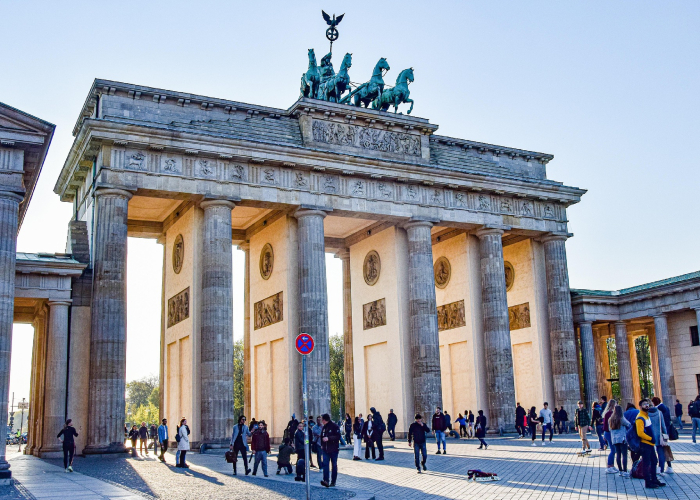
Perched majestically atop the Gate is a breathtaking copper sculpture: a chariot drawn by four horses, driven by a female figure.This is the Quadriga, and its journey is almost more dramatic than the Gate’s.The sculptor Johann Gottfried Schadow created the figure as Eirene, the goddess of peace, celebrating Prussia’s restored peace after years of war.For years, she faced east, welcoming visitors into the city.Then came Napoleon.After defeating Prussia in 1806, Napoleon Bonaparte marched into Berlin.So taken was he with the Quadriga that he ordered it dismantled and shipped to Paris as a war trophy a ultimate symbol of his conquest. It sat there for eight years. But after Napoleon’s defeat in 1814, the Prussian army recovered the statue and triumphantly brought it home.In a powerful act of reclamation, the returned Quadriga was not just restored.It was transformed. The goddess of peace was now the goddess of victory, and her olive wreath was replaced with an iron cross and a Prussian eagle, becoming the Victoria we see today. The gate itself was renamed “Peace Gate,” but the memory of its plunder and return stuck.
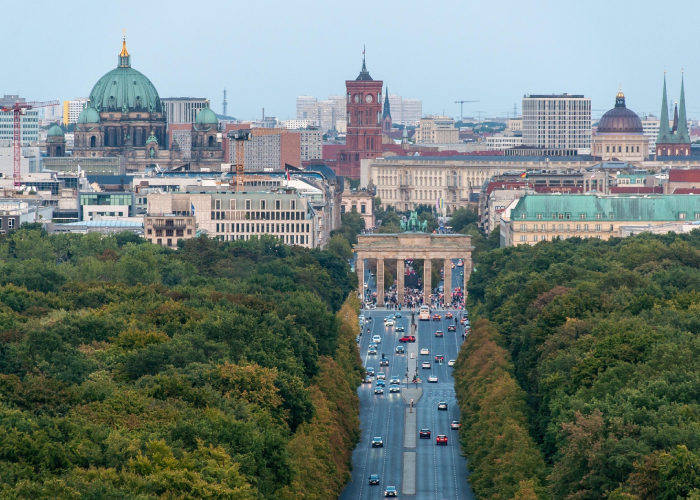
Today, the Brandenburg Gate is more than just Berlin’s most famous landmark.It’s Germany’s version of the Arc de Triomphe, its Statue of Liberty. It’s the place where big events happen like World Cup parties and the annual New Year’s Eve celebration.But its most important role is as a lasting reminder.It shows that even when walls are built to separate people, they can also be broken down. It also shows that symbols can be used to spread ideas, but their real meaning can always be remembered and claimed again.The Brandenburg Gate stands for more than just German unity.It represents a bigger hope: that no division lasts forever, and that peace, even if it’s hard to achieve, is always worth celebrating. It is, and will always be, the heart of Berlin.
Seeing the Brandenburg Gate today is a powerful experience.Here’s how to make the most of your visit.
1. The best time to go: The Gate is magnificent at any hour, but it is truly magical at sunrise or sunset. The golden light illuminates the sandstone, and the crowds are thinner, allowing for a more contemplative moment. At night, it is spectacularly lit, creating a breathtaking silhouette against the dark sky.
2. Where to stand: Don’t just look from one side. Walk through its five passages, once reserved for different classes of citizens. Stand in the vast Pariser Platz and look east down the grand Unter den Linden boulevard. Then, walk through to the west side and see the modern Tiergarten park and the column of the Victory Angel in the distance. This short walk encapsulates Berlin’s journey from its royal past to its green future.
3. What’s nearby: Your visit doesn’t end at the Gate.
Reichstag building: Just a short walk north is Germany’s parliament building, with its stunning glass dome offering panoramic views of the city (booking is essential!).
The Holocaust memorial: A short stroll south brings you to the Memorial to the Murdered Jews of Europe, a profoundly moving and abstract field of stone slabs.
Unter den Linden: Take a walk down this historic boulevard, lined with linden trees, leading towards Museum Island.
4. Feel the history: Stand there and take a moment. Touch the stone. Look up at the Quadriga. Remember that this place has seen everything triumph and loss, war and peace, conflict and togetherness. It’s not just a place to take a photo; it’s an experience.